Your anterior cruciate ligament (ACL) helps stabilize your knee. When it’s working well, you might never think about how important it is. But if you ever experience an ACL tear – a rupture of the band of tissue that runs from your thigh bone to your shin bone – you’ll realize how much you rely on it to move comfortably and confidently.
A torn ACL is a serious but treatable knee ligament injury, so it’s important to seek medical care to ensure that you recover properly. At TRIA, we’ve helped thousands of people heal from torn ACLs. Our fellowship-trained orthopedic surgeons who specialize in sports medicine, physical therapists and other knee experts will use the latest nonsurgical and surgical treatments to restore your knee’s function. We can help you get back to doing what you love, no matter what level of activity that includes.
ACL tears can occur as part of a knee injury related to pivoting or twisting. Each person experiences an ACL tear differently, but there are usually a few telltale symptoms. You may have torn your ACL if you experience:
- Instability – Without the ACL stabilizing your knee joint, you may find that you feel unsteady putting weight on your leg. You may also experience episodes in which your knee moves in ways it isn’t meant to, causing it to momentarily give out.
- Knee pain – The initial pain of tearing your ACL can be moderate to severe. You may also feel pain in your knee during episodes of instability.
- “Popping” – Many people hear a loud “pop” noise when their ACL tears. At the moment of injury, you might also feel a popping sensation in or near your knee joint.
- Swelling – The area around your knee joint will quickly become swollen after an ACL tear. This may limit your knee’s range of motion.
The ACL stabilizes the knee joint by aligning your thigh bone with your shin bone. Although it’s a very strong ligament, it isn’t designed for forceful turning. Because of this, ACL tears can occur when you sharply or powerfully turn your knee in a different direction from your feet, such as during a pivoting motion in sports like basketball, football, soccer or skiing.

ACL tears can be partial or complete, but the vast majority are complete. This means that there’s a full break in the ligament. The type of ACL tear determines what kind of treatment you’ll need, as fully torn ACLs cannot heal on their own.
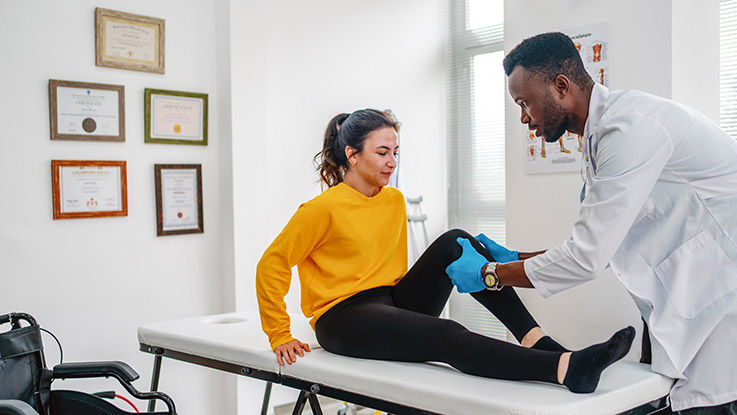
Doctors can usually diagnose a torn ACL with a physical exam by comparing the appearance, sensitivity and function of your injured knee to your uninjured knee. However, we may also order imaging tests such as magnetic resonance imaging (MRI) to confirm the diagnosis and rule out other possible injuries.
There are two main forms of treatment for ACL tears: nonsurgical and surgical. Anyone with a torn ACL can benefit from nonsurgical treatment, but whether you’ll need surgery depends on factors like the severity of the tear, your overall health and what level of activity you want to return to.
The main type of nonsurgical treatment used to treat ACL tears is physical therapy. This treatment uses manual therapy, specialized exercises and other techniques to strengthen the supporting muscles around the ACL to increase your knee’s stability, improve range of motion, and reduce pain and swelling. Physical therapy may be used in combination with other nonsurgical treatments to make it even more effective, such as blood flow restriction, taping and bracing.
If your knee is stable, you have no swelling or pain, and you aren’t trying to return to activities that involve sudden turns or changes in direction, nonsurgical treatment may be all you need. Otherwise, nonsurgical treatments are often used to prepare for and rehabilitate after surgery.
Surgery is sometimes needed to repair or replace a torn ACL. ACL surgeries are generally minimally invasive outpatient procedures, meaning you can go home the same day.
Following surgery, you’ll begin rehabilitation to promote healing and recover your knee’s function. Rehabilitation can help you get better results from your procedure and have a smoother recovery.
The only way to know if you need surgery is to talk with an orthopedic surgeon. They’ll assess the severity of your injury, discuss your recovery goals and explain your treatment options.
Book an appointment online.
Find orthopedic urgent care near you.
Meet our award-winning orthopedists.
No, you don’t need a referral to visit one of our knee specialists. You can make an appointment with an orthopedist online or walk in to one of our orthopedic urgent care locations.
You also do not need a doctor’s order to schedule a physical therapy appointment. However, if you’re making a physical therapy appointment as part of your treatment, your insurance provider may require a doctor’s order for them to cover the services provided during physical therapy. To check what’s covered under your plan, call the number on the back of your insurance card.
Fully torn ACLs cannot heal on their own because the limited blood supply to the injury makes it difficult for blood to clot and start the body’s natural healing process. It’s important to seek orthopedic care if you suspect you’ve torn your ACL to make sure it heals properly.
The only way to know if you need ACL surgery is to talk with an orthopedic knee specialist. They’ll assess your injury, talk with you about your recovery goals, and guide you to the treatment that will get you back to the level of physical activity you desire.
Recovery time for an ACL tear depends on a number of factors, including your age, the severity of the tear, your pre-injury activity level, your overall health and how closely you stick to your rehabilitation plan. Physical therapy programs for ACL tears generally last between 3-6 months. While many people start to feel better after their first session, it can take up to a year to regain your desired level of function, particularly if you’re working back to high intensity or competitive activities after surgery.
We accept most health insurance plans, including Blue Cross and Blue Shield of Minnesota, Cigna, HealthPartners, Medica and many others. To learn how your plan covers the services you need, call the number on the back of your insurance card. Here are member services numbers to help you get started:
- Blue Cross and Blue Shield of Minnesota: 800-382-2000
- Cigna: 800-244-6224
- HealthPartners: 800-883-2177
- Medica: 800-952-3455
- Medicare: 1-800-MEDICARE (1-800-633-4227)
- UnitedHealthcare: 877-842-3210